
TTL 48
Once, many years ago, I went to bed for a “quick nap” at 4 p.m. I woke up the next day. At 8 p.m.
Twenty-eight hours later.
No alarm, just a friend knocking on my dorm room door asking if I was “planning to eat again this week.”
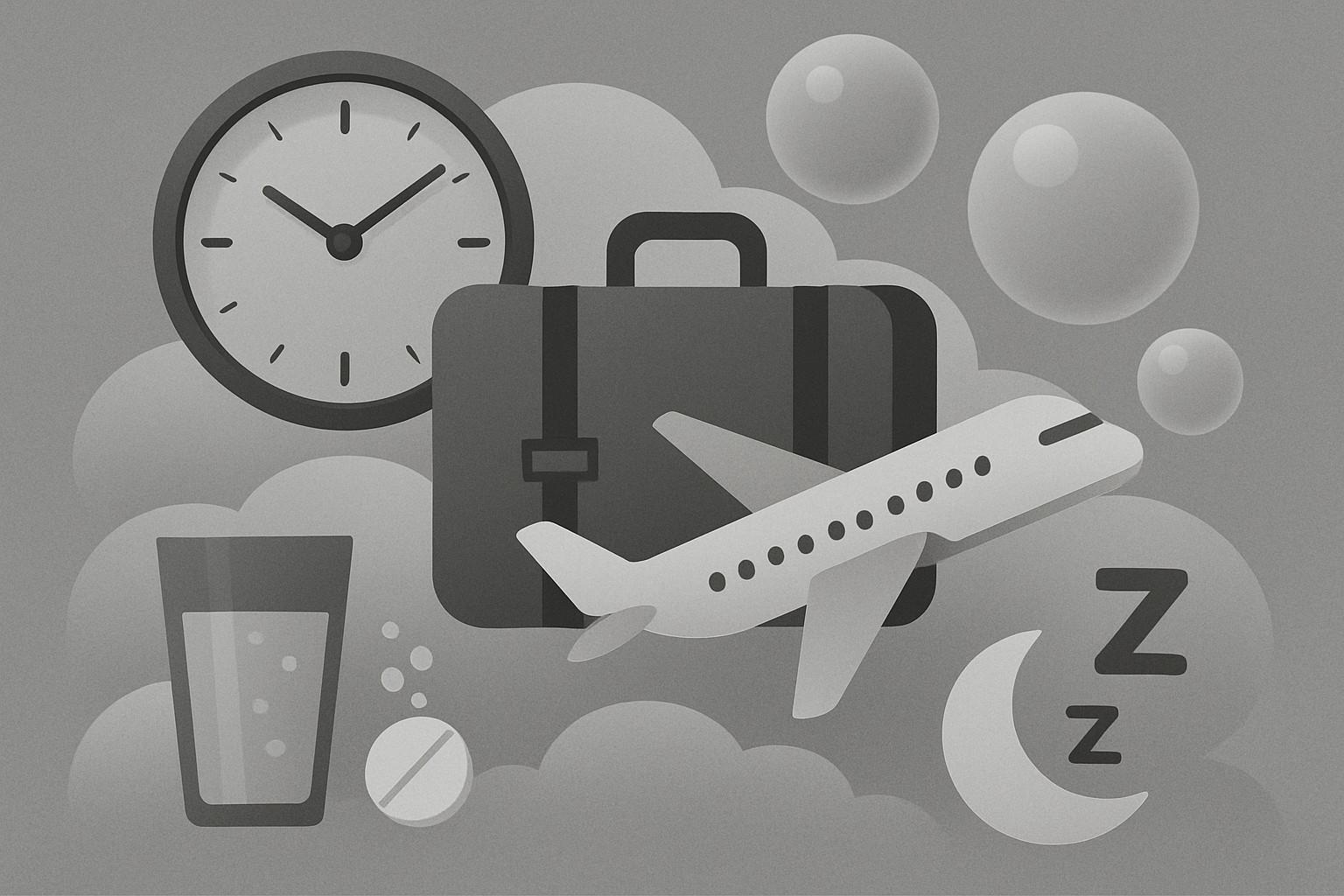
It wasn’t a medical condition nor a burnout, but the mathematical consequence of being a university student who slept two or three hours a night, lived on caffeine tablets dissolved in water, and believed that the laws of biology were optional.
To be honest, that accidental hibernation taught me nothing — except for the fact that my “student life” was a little too much.
But I recently laughed about that episode in a conversation about jet lag.
If I could sleep 2-3 hours a night in the same city, studying and living during the day, what’s the problem with doing it in a different country?
Most of our suffering comes from the way we think about fatigue, not from fatigue itself.
Fast forward a few decades
This year alone, I’ve done 15 work trips—New York, San Francisco, Manila, Hanoi, and more — across time zones and conference and meeting schedules. By now, I know exactly what throws people off when they travel a lot… because I first noticed the mistakes in others before realizing I was doing the same things.
Here’s what I’ve learned:
1. Time zones are mostly psychological—if you stop thinking about them, your body follows.
Just like I realized in college, time is relative.
The moment I step on the plane, I change everything to the destination time: phone, laptop, watch, tablet, internal monologue, life philosophy.
If it’s midnight in San Francisco and I’m boarding at 9 a.m. in Vienna?
Too bad. It’s midnight now. I aim to sleep.
If it’s 4 p.m. in Tokyo when I land after a night flight and I haven’t slept?
I stay awake until night. No naps. Because the “little nap” is not a nap—it’s a trapdoor into a different dimension (maybe not 28 hours, but close).
Most people lose sense of time because they keep thinking “At home it’s X o’clock”, but that sentence alone has destroyed more sleep cycles than caffeine ever could.
2. Hydration is not friendly advice; it’s a survival strategy.
On long-haul flights, I drink about three liters of water.
Cabin air is drier than the Sahara, pressure changes mess with your body, and dehydration disguises itself as fatigue, irritability, and “jet lag.”
I don’t drink alcohol when I travel.
It’s an easy win, and somehow the habitually dehydrated among us never connect the dots. But trust me, it’s much better to call the flight attendant 100 times than to land dehydrated.
3. Caffeine & food are tools.
Use them to control your sleep cycle: a heavy meal will make you sleepy, but a light meal and a coffee will help you stay awake.
This also conveniently reduces the number of airplane meals I have to experience, which is a win for everyone.
5. Noise-cancelling headphones.
Nine or ten hours of constant engine hum drains your brain more than you realize. You need to cut that noise to land feeling like a human.
6. Your habits at home matter more than your habits in the air.
Remember, the problem is not always jet lag: if you sleep poorly at home, you’ll sleep poorly abroad; if you’re a light sleeper, big cities’ noises won’t help; if kids are crying in the hotel room next door, the problem isn’t the few hours’ difference.
Sometimes people blame time zones for problems that are really just… life.
The first few times I went to the U.S., I did everything wrong: wine on the plane because it was free, naps at 3 p.m., devices still set to European time… and then I wondered why I woke up at 2 a.m., unable to function.
With time, I learned the mechanics— but more importantly, I stopped taking jet lag so seriously.
And that takes me back to the 28-hour “nap”. That lifestyle was unsustainable, but it left me with one lesson I still (kind of) use in my business: it’s not about how much you sleep, how tidy your schedule is, or how perfectly everything is coordinated — it’s about how well you adapt, without making a fuss about it.
Adaptation beats control.
And it seems like my 20-year-old self—with his caffeine tablets fizzing in a glass of water— knew it damn well.

If someone forwarded this to you, you can subscribe.
I also publish on paolo.blog and monochrome.blog.

Leave a Reply to Dan Knauss Cancel reply