Scaling beyond human limits
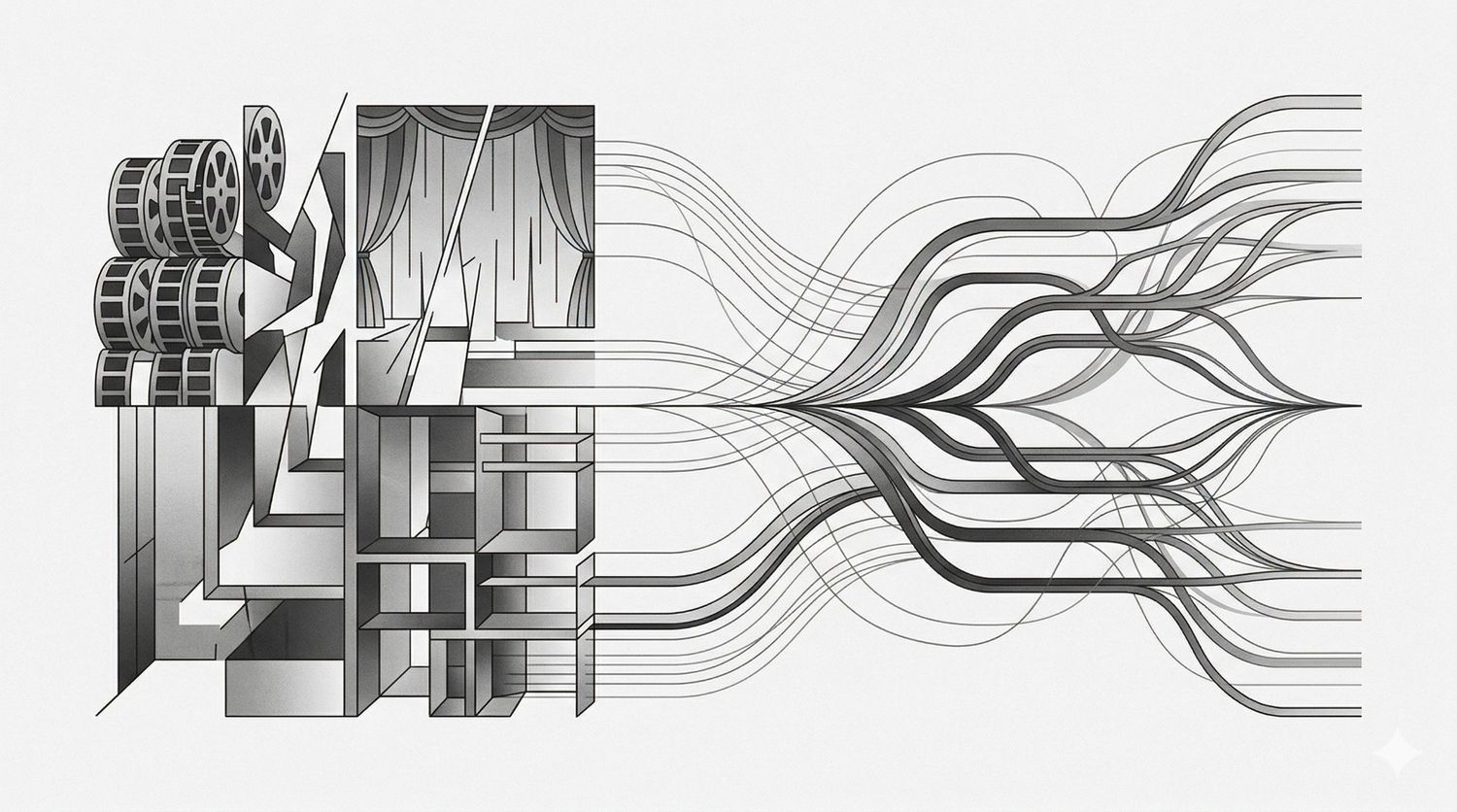
When television was first invented, the early broadcasters simply pointed a camera at a theater stage.
They had a transformative new medium, but they used it to replicate an existing structure because it was their only point of reference.
We are doing the exact same thing with AI today. We apply human frameworks—virtual assembly lines, department silos, and traditional “teams”—because we know nothing else.
We are filming the stage while waiting for someone to invent the language of cinema.
The Shift from Syntax to Strategy
The native organizational structure for AI does not exist yet, but we can see its foundations being laid. Paradoxically, as technical barriers fall, managerial skills are becoming the most critical technical skills.
The most effective software engineers today are often those who were already great engineering managers. AI is rapidly replacing the operational work of writing syntax, but it cannot replace the ability to organize disparate resources toward a common goal.
When you manage a human team, you coordinate different talents. Managing AI requires the same orchestration. Years of management experience—learning how to define outcomes and set constraints—hold more value today than years of syntax memorization.
Organizing the Agents
To move beyond the “filmed theater” phase, we must understand how to structure these new digital resources. Currently, we can organize AI agents in two distinct ways:
- Parallel Agents: Identical agents divide a repetitive task to gain speed. Think of it like a hundred workers on an assembly line, each geolocating a portion of a massive database.
- Specialized Agents: Giving a single agent too many disparate instructions causes confusion. Instead, you deploy separate agents with different contexts, on tasks that do not overlap with each other.
By narrowing the scope of each agent, you increase the reliability of the system—much like how we organize human teams to prevent systemic errors.
Simple Communication, Infinite Scale
The way these agents communicate is surprisingly grounded. They don’t need to mimic human thought processes or possess complex “memories.”
Agents can start fresh every cycle, relying entirely on the written record of a shared document to understand the current state of a project.
This simplicity is the key to breaking our biological bottlenecks. Human organizations have strict structural limits; no tech company can put one hundred thousand people on a single problem simultaneously without the system collapsing under its own weight.
Dario Amodei, the CEO of Anthropic, recently discussed a concept that breaks this biological bottleneck: the Country of Geniuses.
Imagine an AI model that operates at the intellectual capacity of a Nobel laureate—not just in one field, but across every discipline. Now, imagine running millions of these experts in parallel inside a single data center.
In a human system, adding more people eventually slows things down to a crawl. In a “Country of Geniuses,” you can deploy a city-sized workforce of elite specialists to solve a single problem in hours.
But this is just our current model at scale. Who knows what will happen in the future.
The leap from theater to cinema required a change in language: cuts, close-ups, and non-linear storytelling. The leap in AI will happen when we stop trying to make agents act like us and start letting them work in ways only they can.
Do you have any idea about how the new model will be structured?

If someone forwarded this to you, you can subscribe.
I also publish on paolo.blog and monochrome.blog.